
What Every Contractor Needs to Know Right Now
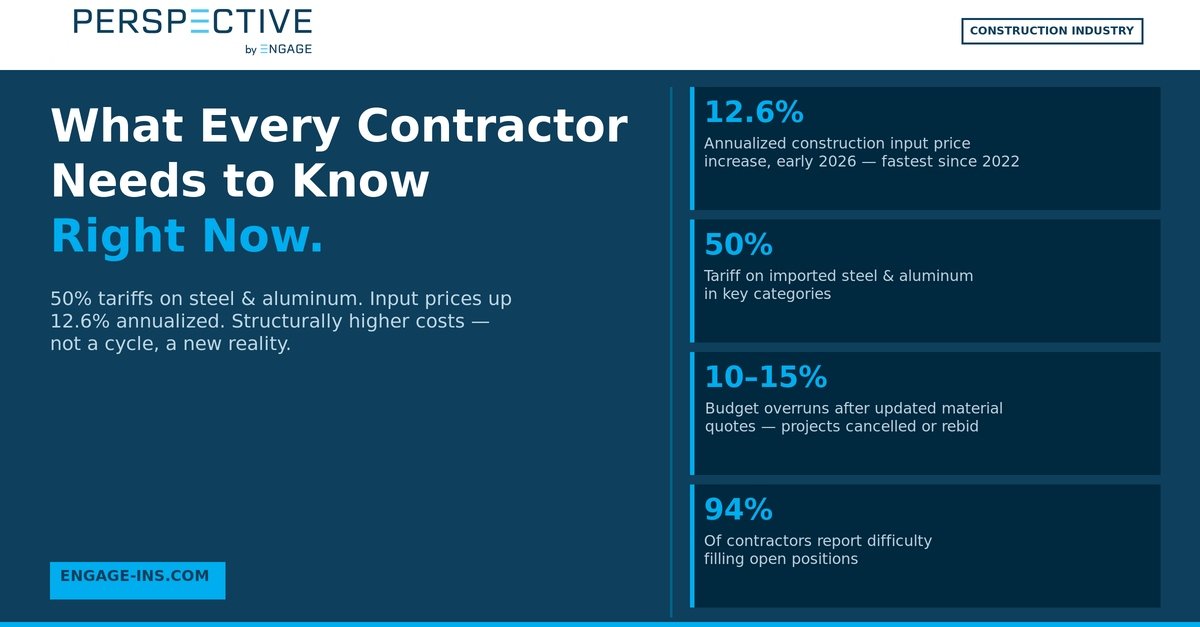
If you're in construction, you already know 2026 is going to be different. Material quotes come in higher than expected. Projects are getting rebid. Some jobs are getting shelved altogether. And if you're trying to figure out whether to lock in pricing or wait for conditions to ease, you're late to the party.
Here's what the data is actually telling us.
The cost picture has fundamentally shifted
Tariffs on imported steel and aluminum have reached 50% in some categories. Nonresidential construction input prices surged at a 12.6% annualized rate in early 2026, the fastest pace since 2022. Industry estimates put total project costs running 4–9% above 2024 baselines depending on material type. Contractors across the country report having at least one project in the past year cancelled, rebid, or significantly scaled back after updated steel, aluminum, or equipment quotes came in 10–15% over original budgets.
That's not a bidding problem. That's a structural cost environment that has changed faster than most business models were built to absorb.
The pressure doesn't stop at materials
Labor remains one of the defining constraints in the industry. Nearly 94% of contractors report difficulty filling open positions. Wage escalation continues. Schedule risk is compounding. When a project runs longer than planned because of material delays, labor shortages, or rework. Every additional week carries financial exposure that wasn't priced into the original job.
Understanding these dynamics isn't just useful for bidding. It's essential for understanding where your real risk sits at any given moment in a project's lifecycle.
What this means beyond the job site
The broader economic forces driving construction costs that range from tariff policy, global supply chain realignment, labor market tightness aren't temporary. They represent a structural repricing of what it costs to build in the United States. That has downstream consequences for every financial assumption tied to a project: financing costs, contingency reserves, insurance valuations, and income projections.
One of the most overlooked consequences of a rapidly changing cost environment is the gap it creates between what things actually cost to replace today and what your financial protections were written to cover. In a stable pricing environment, that gap is small. In an environment where nonresidential input costs have moved nearly 13% annualized, that gap can be significant, and it tends to surface at exactly the wrong moment.
Coverage for tools, equipment, vehicles, and completed work is built on valuations. Builder's risk policies, general liability limits, workers' comp classifications, and business income coverage were all written based on a cost baseline that may no longer reflect current reality. Contractors who understand this proactively are the ones who navigate hard environments successfully, not because they found the cheapest coverage, but because they understood their exposure before something forced the conversation.
The Perspective
At Perspective, our goal is to give contractors and business owners a clearer view of the economic forces shaping their industry, and the financial implications that follow. Our mission is to be informative because in an environment this dynamic, the contractors who come out ahead are the ones making decisions from a position of clarity.
Engage Insurance Group is an independent insurance agency specializing in construction insurance and risk management. Learn more at engage-ins.com.