
3 Ways to Save in This Economy — And Protect What You’re Building
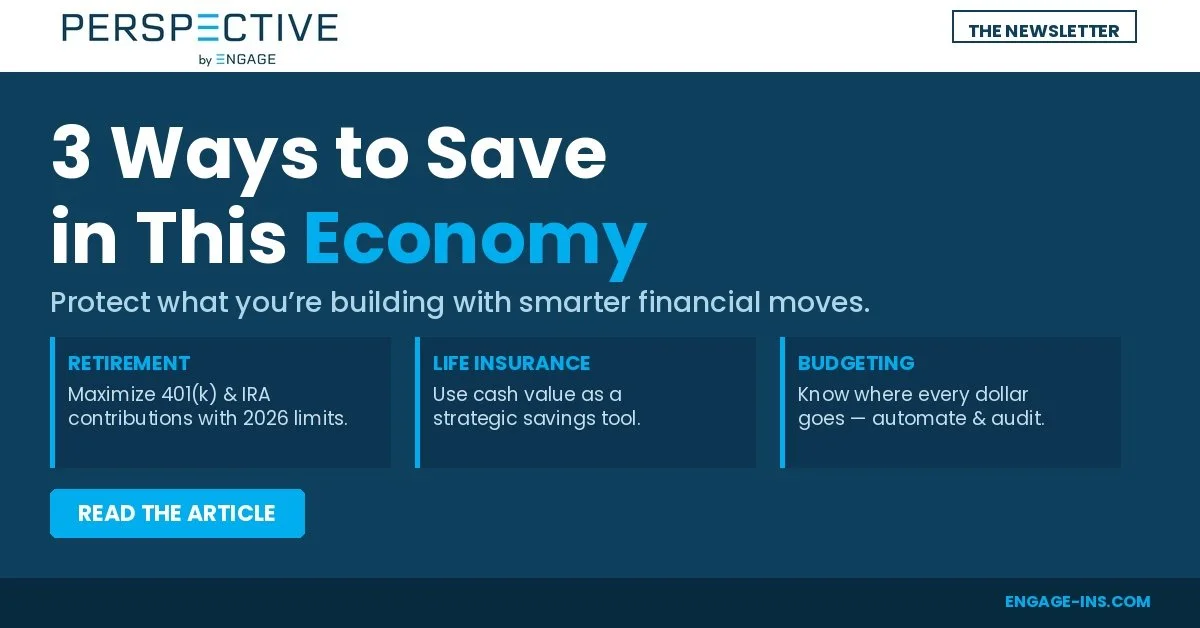
The economy in 2026 is sending mixed signals. Inflation has cooled from its early-decade highs, but the cost of living remains stubbornly elevated in many parts of the country. Interest rates are shifting, markets are unpredictable, and for a lot of people, it feels like the ground keeps moving beneath their feet.
Here’s the reality: you can’t control what the economy does. But you can control how you prepare for it. Saving in this environment isn’t about cutting back on everything — it’s about being intentional with the money you have and making sure your financial foundation can absorb whatever comes next.
At Engage Insurance Group, we believe that protecting what you’ve built is just as important as building it. That starts with three strategies that too many people overlook.
1. Maximize Your Retirement Contributions — The Limits Just Went Up
If you haven’t looked at your retirement account contributions recently, now is the time. The IRS raised the annual 401(k) contribution limit to $24,500 for 2026, up from $23,500 last year. For traditional and Roth IRAs, the new cap is $7,500, up from $7,000.
Those numbers matter. An extra $1,000 in a tax-advantaged account might not sound dramatic today, but compounded over ten or twenty years, it becomes significant. And if you’re 50 or older, catch-up contributions let you add another $8,000 to your 401(k) — bringing your total possible employee contribution to $32,500.
There’s an even bigger opportunity for workers between 60 and 63: the SECURE 2.0 Act introduced a “super catch-up” provision, allowing enhanced contributions of $11,250 in that age window. If your mortgage is shrinking and the kids are off the payroll, this is the time to lean in hard.
What to do right now:
If your employer offers a match, make sure you’re contributing enough to capture every dollar of it. That match is essentially free money — and it’s often 3% to 6% of your salary.
Bump your contribution rate by even 1% or 2%. You’ll barely feel it in your paycheck, but the long-term impact on your nest egg is real.
If you’re self-employed or own a business, talk to your CPA about a SEP IRA or Solo 401(k) — the contribution ceiling for SEP IRAs is now $72,000 in 2026.
The bottom line: saving for retirement isn’t a set-it-and-forget-it checkbox. The limits change, your income changes, and your strategy should evolve with them.
2. Use Life Insurance as a Financial Tool — Not Just a Safety Net
Most people think of life insurance as something you buy to protect your family if the worst happens. And that’s true — it is. But life insurance can also play a strategic role in how you save and plan for the future.
Here’s what a lot of people don’t realize: permanent life insurance policies — such as whole life — include a cash value component that grows tax-deferred over time. That means the money accumulating inside your policy isn’t being eroded by annual capital gains taxes the way a standard brokerage account might be.
Now, to be clear, this isn’t a get-rich-quick play. Cash value builds slowly in the early years, and whole life is not a replacement for an emergency fund or a retirement account. But when it’s part of a broader financial strategy — layered alongside your 401(k), IRA, and other savings — it becomes another vehicle for building long-term wealth with built-in protection.
A few things to consider:
Term vs. whole life isn’t an either/or decision. Many families benefit from a blended approach — affordable term coverage to protect against the unexpected today, combined with a permanent policy that builds cash value over time.
Premiums stay locked in. Unlike term policies that get significantly more expensive to renew as you age, whole life premiums are fixed from the day you sign. That predictability has real value when everything else in the economy feels uncertain.
It’s about what fits your life. A young family with a tight budget might start with term coverage and add a permanent policy later. A business owner with more cash flow might use whole life as part of an estate or succession plan. There’s no one-size-fits-all answer — and anyone who tells you otherwise isn’t looking at your full picture.
The key is working with an advisor who understands your situation and isn’t just pushing a product. As an independent agency, Engage doesn’t represent any single carrier — we shop the market on your behalf to find coverage that actually fits.
3. Get Serious About Budgeting — Know Where Every Dollar Goes
This one sounds basic. It’s not. Most people have a general sense of what they earn and what their big bills are, but they have no idea where the rest of it goes. And in an economy where everyday costs — groceries, fuel, subscriptions, dining out — have quietly crept higher over the past few years, that gap between what you think you spend and what you actually spend can be enormous.
Budgeting isn’t about restriction. It’s about awareness. When you know exactly where your money is going, you can make intentional choices instead of wondering at the end of the month why there’s nothing left to save.
Here’s how to make it work without turning it into a second job:
Automate your savings first. Set up a transfer to your savings account the same day your paycheck hits — even if it’s a small amount. What you don’t see in your checking account, you won’t spend. Consistency beats intensity every time.
Audit your fixed costs. Before you cut the small pleasures, look at the big recurring bills — insurance premiums, phone plans, internet, streaming bundles, memberships. Many of these are negotiable or replaceable with better options. One hour of reviewing fixed expenses can create permanent breathing room in your budget.
Use a budgeting tool that fits your life. Apps like YNAB, Monarch Money, or even a simple spreadsheet can give you a clear picture of your spending patterns. The best budgeting system is the one you’ll actually use — so don’t overthink it, just start.
Set quarterly check-ins, not just annual resolutions. The economy moves fast, and your financial situation can shift in a matter of months. A quick review every 90 days keeps you on track without feeling overwhelming.
The goal isn’t perfection. It’s progress. Even redirecting an extra $200 a month toward savings or debt payoff adds up to $2,400 a year — and that’s money working for you instead of disappearing into expenses you didn’t even notice.
The Bigger Picture
Saving in this economy isn’t about one silver bullet. It’s about layering smart moves — maximizing retirement contributions, using life insurance strategically, and budgeting with intention so your money goes where it matters most. Each piece reinforces the others.
And that’s what we’re here for. Engage Insurance Group exists to help you navigate the uncertainty not by selling you a policy and disappearing, but by being a partner who understands your full financial picture and helps you protect what you’re building, every step of the way.
Engage Insurance Group is an independent insurance agency specializing in insurance and risk management. Learn more at engage-ins.com.