
What Happens When the Paycheck Stops?
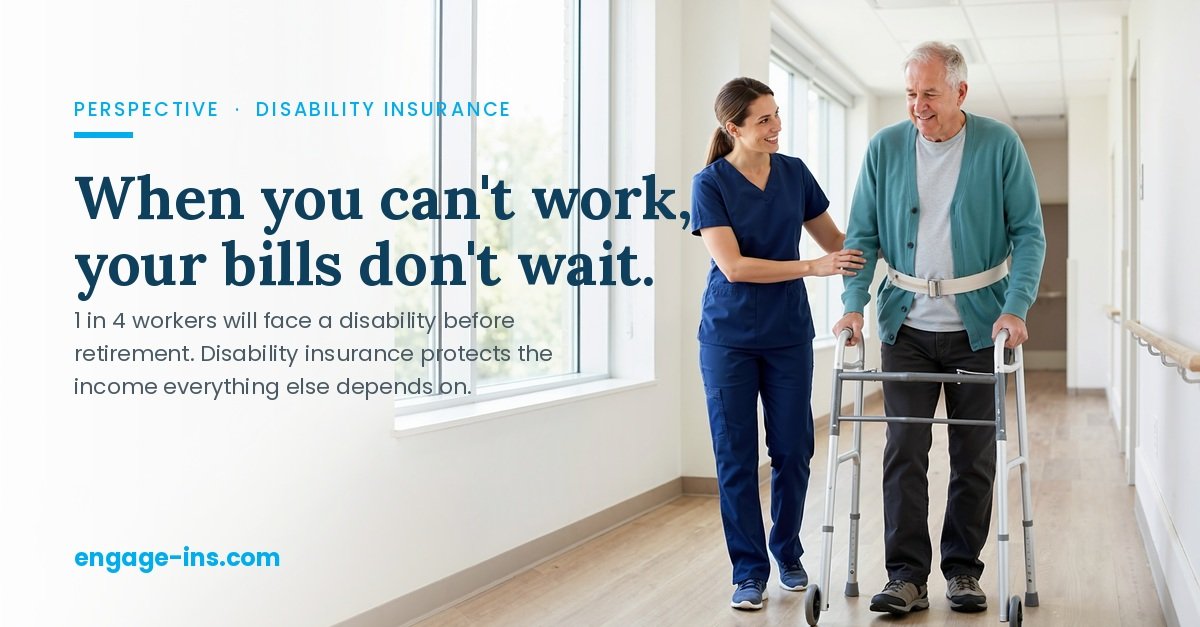
What actually happens when disability strikes and you have no coverage — and the three things employees and business owners should weigh before it does.
Most of us insure the things we can see. The house. The car. The building. Yet the single asset that pays for all of them, which is your ability to earn an income, is the one item most often left uninsured. Nine out of ten workers underestimate their own odds of a disabling event, and the data doesn't support the optimism: roughly one in four of today's twenty-year-olds will be out of work for a year or more before retirement, and about three in ten workers between 35 and 65 will experience a disability lasting 90 days or longer.
When that happens without coverage, the question is no longer medical. It's financial and the wrecking that comes with it. Here is what the fall actually looks like, and what to weigh before you're in it.
The safety net most people count on has holes
Two assumptions do the most damage. The first is “workers' comp will cover me.” It won't unless the injury or illness is work-related, and close to 90% of disabling events are not. A back injury from a weekend project, cancer, a heart condition, a car accident on personal time: none of it triggers workers' comp.
The second is “Social Security will catch me.” SSDI exists, but it was never designed to replace a working income. In 2026 the average monthly SSDI benefit is about $1,630, and the program denies more than 60% of initial applications. Approval commonly takes six to eight months (longer with appeals) and there is a mandatory five-month waiting period before benefits begin at all. Medicare coverage doesn't start until two years after your first SSDI payment. For most households, that is a year or more of near-zero replacement income while the mortgage, groceries, and premiums keep their regular schedule.
That gap between the day income stops and the day any benefit arrives, and between that benefit and what you actually earned is where the financial damage happens.
Three things employees should weigh
1. Your fixed costs don't care that your income stopped. Start with the number that matters: the monthly obligations that continue no matter what — housing, utilities, food, minimum debt payments, existing insurance. Compare that to what you'd actually receive if disabled. If the honest answer is “I'd drain savings in a few months,” you've quantified your exposure. Nearly four in ten Americans can't cover a $400 emergency without borrowing; a disability is that shock multiplied over months or years.
2. Employer group coverage is a starting point, not a plan. If your employer offers short- or long-term disability, understand its limits before you rely on it. Group plans typically replace around 60% of base salary (excluding bonus and commission), cap at a monthly maximum, are taxable when the employer pays the premium, and end when your employment does. A disability that costs you your job can cost you the coverage in the same moment. Workers in construction, retail, and service industries have among the lowest access to employer disability coverage to begin with.
3. Read the definition of “disabled,” it's the whole ballgame. Two policies with identical premiums can behave completely differently based on one clause. “Own-occupation” coverage pays if you can't perform your specific job; “any-occupation” pays only if you can't perform any job you're reasonably suited for. For a surgeon, an electrician, or anyone whose income depends on a specific skill, that distinction separates a policy that protects your career from one that barely protects your survival. The waiting period (elimination period) and how long benefits last matter just as much as the monthly figure.
Three things business owners should weigh
Business owners carry a double exposure: you are both the earner and the enterprise. A disability threatens two things at once — your household income and the business that generates it.
1. The business has bills that don't stop when you can't work. Rent, payroll, loan payments, utilities, and insurance continue whether or not you're at the desk. Business Overhead Expense (BOE) coverage is built specifically to reimburse these fixed operating costs so the doors stay open while you recover — turning a potential closure into a pause. It is separate from, and additional to, personal disability coverage.
2. Your personal income needs its own protection — you have no employer to lean on. Owners often assume the business will keep paying them. In practice, a business without its key operator frequently sees revenue fall precisely when expenses don't. Personal disability coverage that replaces your owner's income is what keeps your household solvent, independent of how the business performs during your absence.
3. Partners and lenders need a plan in writing. If you co-own the business, what happens to your share — and your partner's obligations — if you're permanently disabled? A disability buy-out arrangement, typically funded by insurance, lets remaining owners purchase a disabled partner's interest without draining the company or forcing a fire sale. Lenders and personal guarantees add another layer: many loans assume your active involvement, and a disability can create real pressure. Documenting the plan before it's needed is the difference between an orderly transition and a crisis.
Where an independent agency changes the math
Disability coverage is not one product. It's a set of decisions — occupation class, definition of disability, elimination period, benefit period, cost-of-living riders, business versus personal structure — and the right answer depends entirely on your income, your industry, and your obligations. A captive agent can offer one carrier's version. As a fully independent agency, Engage represents more than 120 carriers, which means the recommendation is built around your exposure — not a single company's product shelf.
The best time to have this conversation is while you're healthy and working because once you have the injury, can no longer be buy coverage.
Engage Insurance Group We are an independent risk management firm built on a simple conviction: that you deserve coverage decisions driven by your needs, not our incentives. This independence changes everything. Learn more at engage-ins.com.